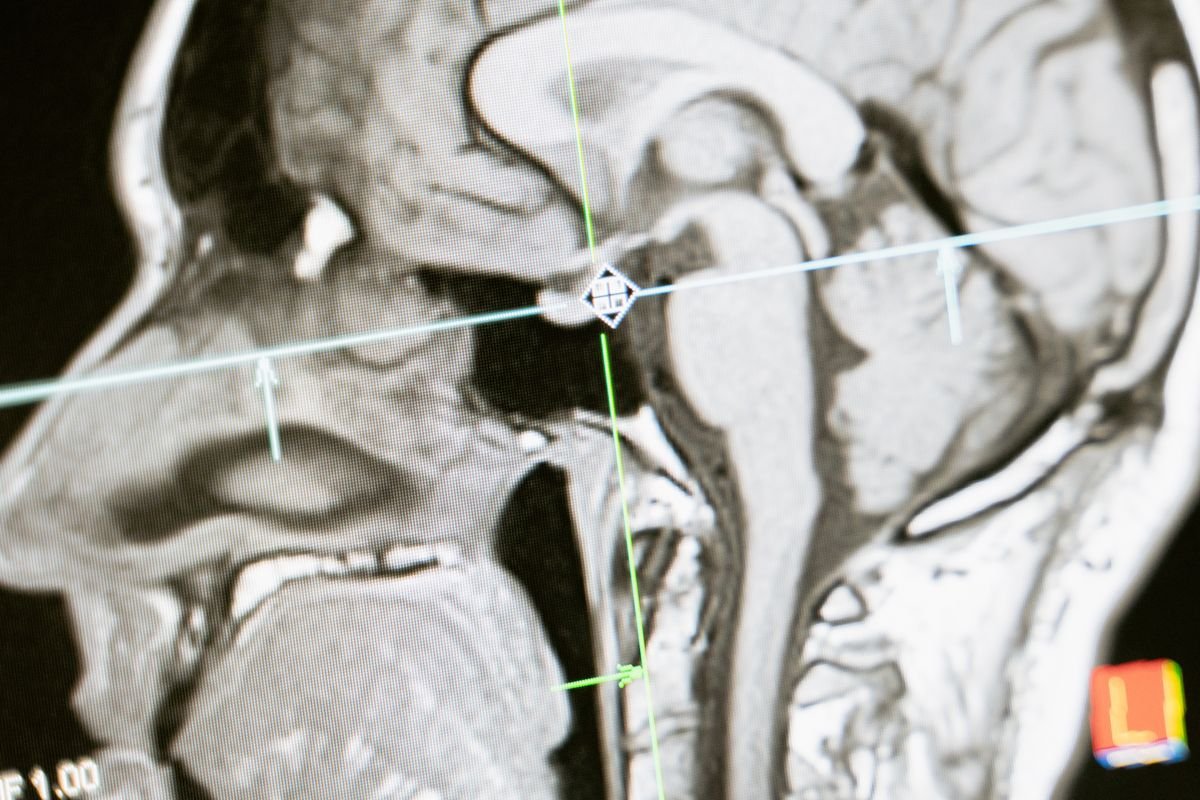
A fire alarm that goes off from shower steam isn’t protecting anyone any more — it’s just making noise. The same goes for when your fear fires at a situation that no longer represents real danger: sending a message, asking for a raise, ending a relationship that no longer makes sense. The brain doesn’t know the difference between a lion and a social rejection — and there is a very concrete neurological reason for that.
The fast route and the slow route of fear
Neuroscientist Joseph LeDoux described two pathways by which information about a threat reaches the brain. The first — the fast route — runs from the thalamus straight to the amygdala, the structure responsible for detecting threats and firing the fight, flight or freeze response. This path is fast but crude: it reacts to general patterns (a sudden movement, a tone of voice, an angry face) before you consciously know what is going on.
The second pathway — the slow one — goes through the thalamus, then the cortex, where the information is analysed with more detail and context, and only then reaches the amygdala. This route is slower but more accurate: this is where you realize that “lion” was only a shadow. The problem is that, in a moment of perceived threat, the fast route always wins the race. The amygdala has already fired the emergency response — racing heart, short breath, tunnel attention — before the prefrontal cortex has had time to assess whether the threat is real or merely looks like one.
Why fear generalizes
This also explains why a specific fear spreads to wider and wider situations. In classic fear conditioning experiments, a neutral stimulus paired just once with a painful experience is enough for the brain to start treating it as dangerous — and that association tends to generalize to similar stimuli. A painful rejection at 16 can train the amygdala to fire not only at that specific person, but at any situation that resembles it, however remotely.
That’s why the “worst case” you imagine is rarely proportional to the real risk of today’s situation — it’s proportional to the intensity of the original experience that taught the fear.
Extinction: how the brain unlearns a false alarm
The good news is that this response can be retrained — but not by the route most people try first, which is avoiding the situation. Avoiding the trigger actually teaches the brain the opposite of what you want: it confirms that the situation really was dangerous (because you only felt “safe” once you had escaped it).
The mechanism that actually switches off a learned fear is called extinction. It consists of exposing yourself to the trigger in a safe context, repeatedly, until the prefrontal cortex — the ventromedial region specifically — learns to actively inhibit the amygdala’s response. Extinction doesn’t erase the original fear memory (which is why fear can return under stress); it creates a new, stronger memory telling the brain that the situation is, after all, safe. It’s a race of repetition between two circuits — the one that already existed and the one you are building.
From the neuroscience to the protocol
This is the logic behind the Fear Protocol: naming the exact situation (not the generic fear, but the concrete trigger), identifying the body’s automatic reaction, and — the decisive step — designing gradual, repeated exposure to that specific situation, in conditions where you can stay present long enough for the prefrontal cortex to do its work. Every time you go into the trigger and come out of it without the disaster the amygdala predicted, the new safety memory gets a little stronger.
If this process has such a concrete basis in how the brain learns and unlearns threats, it makes sense to work at it in a structured way — not waiting for the fear to disappear on its own, but deliberately teaching your brain that the alarm no longer needs to ring. The Fear Protocol walks you through that process, trigger by trigger.
Keep on to exploring how to switch off those false alarms, or why chronic guilt uses the same circuit to keep you tied to the past.
Want to apply this in a structured way? The Fear Protocol (PDF, $9) walks you through it step by step: naming the exact trigger, mapping the body’s reaction, and designing the gradual exposure that switches the alarm off.

Leave a Reply